Many years ago, I became acquainted with an older woman who devoted much of her life to social justice. Raised in a more conservative Christian home, she rejected her childhood faith for a more humanistic approach to life and a spirituality she described as “universal and mysterious.”
Now in her early 80s, this remarkable lady was living and teaching within an indigenous community in the southern US after a lifetime of other meaningful and often sacrificial forms of service. I found her inspiring and appreciated getting to know her when we were both invited to serve on the board of a non-profit organization.
She also had very little patience for people she perceived to be “too Christian.” Along with the negative influence of her childhood faith, she had encountered too many other followers of Jesus she experienced as judgmental, hypocritical, and other less flattering adjectives. Since I was a pastor at the time, I was immediately suspect. On the day we were introduced to one another, it was clear she did not want anything to do with me, even though she had not yet uncovered and experienced some of the many unflattering adjectives that can legitimately describe me…
But eventually, as we continued to cross paths and our shared love for the organization’s work became apparent, she warmed up to me. Since our board met in various places around the US, it provided many mealtimes and evenings for conversation. In these more informal settings, we often found ourselves sitting together. Her fierce passion for social justice was only eclipsed, it seemed, by her personal quest to liberate others from the shackles of restrictive religion, fundamentalist bigotry, and another long list of unflattering adjectives that might describe any faith that did not meet her standards.
Our initial visits were more lecture than conversation, as this otherwise lovely woman offered a blistering appraisal of a more orthodox Christianity and a withering attack on the branch of Friends (those with pastors and who do not meet exclusively in silence) I participated in. But over time, we also found we shared everyday experiences. To her great surprise, I had read many of the same authors she found so central to her understanding of spirituality. We cared about many of the same issues and concerns. Our lives overlapped in countless ways. And though it was hard not to want to offer a solid rebuttal to some of her more baseless arguments, I was learning how this rarely helps in these instances. Instead, I tried to listen carefully, affirm whatever pieces or points I could, and I could also invite her to consider some alternative explanation or another plausible point of view.
Over our friendship, her health began to deteriorate as she aged. She was now making plans for her death, and it was clear that she was thinking more deeply about her mortality and her relationship with God/Spirit/the Mysterious Other. The last time we were together, we shared a taxi to the airport after our board retreat. In the back seat of the car, she leaned over to me and whispered,
“I had a dream a few weeks ago. I died and went to heaven. It felt like I was standing outside my true home, but a wall separated me from what and whoever was on the other side. I was there hoping to get in and anxiously wondering who would meet me. Suddenly, the door flew open, and there was Jesus. It was Jesus—can you believe it!”
By now, she had tears in her eyes and whispered even more silently, “Maybe it is Jesus, after all.”
As the cab approached the terminal, I invited her to lean into that dream. Rather than rejecting it out of hand or deciding it can’t be true because it disrupts her sense of mystery—maybe, just maybe, God was speaking to her. Wiping her eyes, she laughed, hugged me, and said, “I knew you would say that. All right! I will be open to it even though I don’t want to. And who knows—maybe it is Jesus, after all!”
Maybe it is Jesus, after all.

Within my spiritual tradition (Quakers), we tend to focus so much on the present encounter with God that little time or thought gets given to what lies beyond death. Rather than falling into the trap of viewing a relationship with God as a “ticket to heaven” or that it really only matters in eternity, Friends (and other similar Christians) focus on developing and deepening a relationship with God in the present. Now is when life with God happens because this moment is when the opportunity to know and love God is genuinely available. The past is gone, and the future is uncertain.
But death is a marker that matters, and every faith tradition wrestles with what it means to be reconciled with God before our lives here on earth come to a close. Theologians, including those within the Quaker tradition, have written countless volumes on the mechanics, methods, principles, and propositions around being reconciled with our Creator. And most people I know wrestle with this same question, wondering what it means to be at peace with God on both sides of the grave. Even my friends who do not believe in God or who reject the idea that humanity can ever fall outside the mercy and grace of an all-encompassing and universal Love—often have very clear and detailed ideas about what happens at the point of death. Maybe we are all theologians—whether we like it or not.
I love theology—and have spent most of my adult life reading, thinking, praying, teaching, and rethinking what it means to study (ology) God (theos). Like my sometimes courageous friend, I agree that God is mysterious. There are so many unknowns and so many unanswered questions. Apparent contradictions and, as far as I can tell, a nearly endless supply of paradoxes arise along the way. It is no wonder some folks determine God is an unsolvable puzzle—a Mystery we may long to unlock but are helpless to do so. Others create rigid formulas and step-by-step instructions for what one must think, say, and do about God to solve the puzzle correctly. Frankly, this approach sometimes feels more like Magic than faith when the language of prayer devolves into incantations, and sacramental devotion takes on the flavor of hocus pocus. Say these words, hold these truths, do these rituals—in just the proper manner—and all will be well.
Maybe somewhere between Mystery and Magic, there is Movement toward God in which we learn to experience the mystery in a way that leads to knowing. Where the unparalleled power and presence of the Divine dispels human wizardry. Where our seeking God leads to finding. Where our passionate quest for answers leads us to an ongoing discovery of Truth. And where our sense of feeling lost, wandering, isolated, or abandoned becomes the spark to begin our journey home.

Throughout the bible, there are all kinds of allusions to Jesus being our peace. Somehow, through his birth, life, death, resurrection, and ongoing presence, we can be reconciled to God, our neighbor, creation, and even that most crafty adversary—ourselves. In considering peace with God, there is a passage of Scripture that I find particularly helpful—Romans 5:1-2:
“Therefore, having been justified by faith, we have peace with God through our Lord Jesus Christ, through whom also we have access by faith into this grace in which we stand, and rejoice in the hope of the glory of God.”
One theologian reminds us that the context is not a battleground where God is at war with us. Instead, peace is a restored relationship between God and humans—just like you and me. The brokenness and alienation, so prevalent and pervasive throughout history and in our own lives, are mended, set right, and reconciled by the God who is for us and who desires peace. Within this verse, the picture it evokes is not one of you, me, and God standing near each other and preparing to sign a peace treaty. Instead, the word “with” is active, “implying motion or direction.” Some writers suggest that what we find here is a picture of a man or woman moving forward, unhindered, toward a welcoming God who is eager to embrace us.
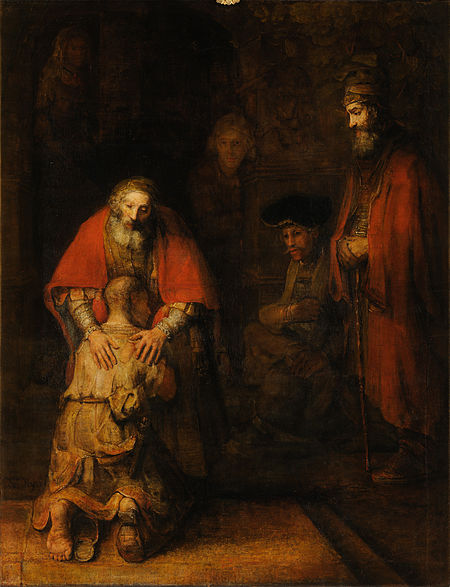
Maybe the most lovely biblical image of this is the prodigal son returning home after his wanderlust ends him in misery and turmoil. At his lowest point, he returns home, hoping to be taken on as a hired hand. He could not imagine being received back as a son. To his delight, the heartbroken father—who had been watching and waiting for him since the day he left home—rushed to greet him and immediately celebrated his return. The lost boy was home, and the hostility he feared was nothing other than an all-embracing peace that had been there all along.
Of course, not everyone is a prodigal in a pit of despair. Many people go about their ordinary lives, often doing great good, just like my delightful old friend. She once complained to me about theologies that envisioned an angry god, one that caused people to feel guilty or tried to convince them they were unacceptable. “People,” she said, “are on their own path, doing their best, which should be good enough.”
As I listened and she talked, her lament over the brokenness in the world was also voiced. Her pain at human violence, injustice, suffering, and the alienation she had experienced within her family and circle of friends bubbled to the surface. She admitted that many, many people wrestle with feeling alienated from God, wishing to feel forgiven for the harm caused and mistakes made.
Though I didn’t quote Romans 5 to her, I did suggest that maybe the Christian story and the message of Jesus were much more about a path to peace than appeasing an angry god. Learning to abide in his life, receive his grace, and walk in his way may be part of how we find our way home.
As far as I can see, this longing for “home” aches within many of us throughout our lives, not just when we are staring into the face of death. While admittedly still a novice theologian, I have come to believe the experience of being at home in God is both a promise and a possibility we can receive at any and every moment. No matter where we are starting from—we can always go home. And maybe there is One moving to meet, greet, and welcome us on our way, ready to embrace us if we are at all open to the possibility. And as my dear old friend suggests, maybe it is Jesus, after all.
Peace to you!
 Walking in the Way and Stumbling Toward Faithfulness
2 responses to “On Death part 7: Being at Peace with God”
Very thoughtful and moving piece. You are a wise man, a profound Christian, and a great pastor, and, I am sure, exceptional leader. Arne
LikeLike
You are very kind and clearly a little delusional! 😜 But thank you. I wish we would have had more opportunities to visit over the years. I would be better for it. Peace to you and Ruthanne!
LikeLike