This is a text of a message given to the Friends World Committee–Section of the Americas–in March 2026. Their theme was “Love Your Neighbor.”
I am so glad that FWCC chose to highlight neighbor love as the theme for this gathering. I can’t think of anything more crucial or desperately needed right now. In a world that often feels like it is on fire and out of control, this is something concrete and tangible we can do as people committed to embodying the love of Christ. In a world that is more apt to put up a fence, or build a wall to keep a neighbor out, or use a gun or a bomb or financial pressure to make a neighbor fear us—what would it mean for a group of people—even our size—to make love be our first motion toward any and every neighbor we encounter? It might not change the world for everyone, but it might change it for someone or a few.
You might think that the practice of “loving your neighbor” would be simple, right? I mean, how hard can it be? I have great neighbors—kind, generous, and caring people whom I feel affection for almost all the time. But then I remembered that all my neighbors have to deal with me! Maybe I am the problem neighbor? Maybe I am the reason Jesus and the biblical writers made this such a central teaching. I think it is important to consider this possibility, at a time when so many people are struggling to love their neighbors: Am I easy or hard to love?
In the time we have today, I would like to consider the story of the Good Samaritan, but maybe from a different perspective than we normally read it.
I imagine most of us are familiar with the parable Jesus teaches in Luke chapter 10. A scholar of the law shows up to test Jesus on what qualifies a person for eternal life. But rather than answering his question, Jesus turns it back on the scholar & asks, “How do you read the Law?” His answer is flawless—combining the heart of the Old Testament by coupling the command to love God above all else (Deuteronomy 6:5), with the command to love your neighbor as yourself (Leviticus 19:18).
Jesus and the scholar are in agreement, which should be cause for celebration! They are on the same side for once! But the scholar is not really interested in learning, or deepening faith, or aligning his heart with the heart of God. He is trying to expose what he believes are Jesus’ heretical views. So, he presses further and asks, “But who is my neighbor?”
As he often did in situations like this, Jesus says: “Let me tell you a story.”
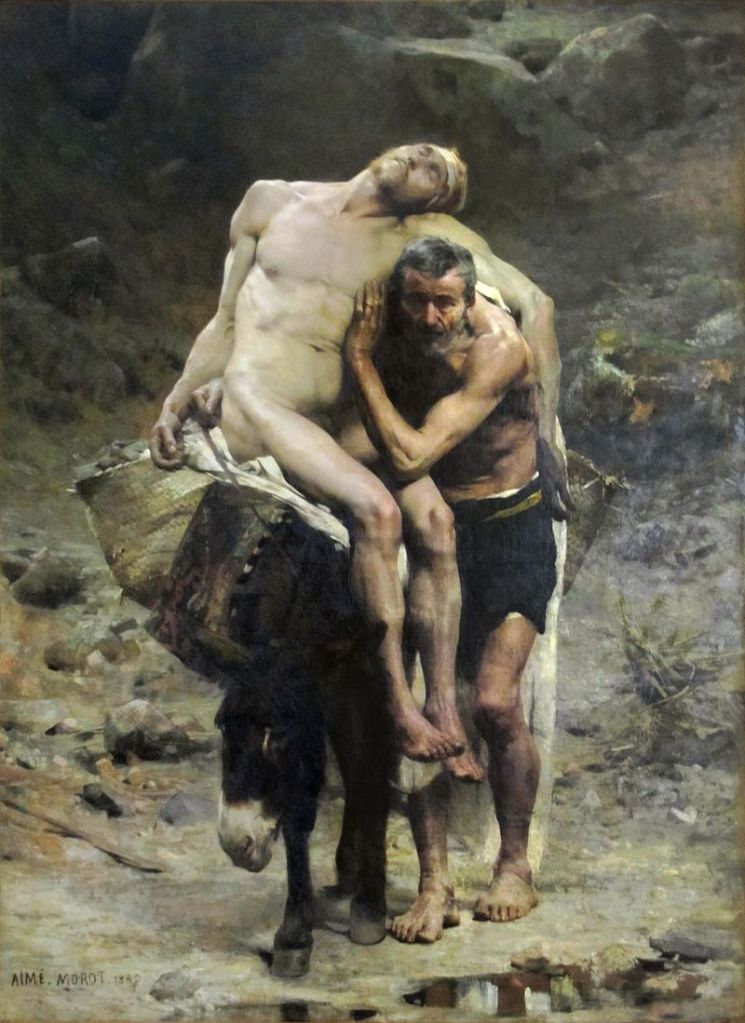
Once upon a time, a man journeyed from Jerusalem to Jericho, down a long, dangerous path where robbers often hid. Sure enough, the man is attacked. He is beaten, stripped of his clothing, and left for dead. Along came two religious leaders, members of his own spiritual community. But rather than stopping to see how or if they might help the injured man, they distance themselves, steering clear of him completely.
Later, a Samaritan (an outsider) comes along. He sees the injured man, and his heart is stirred with compassion. As is often the case, compassion also moves him—emotionally and physically—toward the man in need. He pours oil and wine on his wounds, bandages him, loads him onto his donkey, and takes him to an inn. Using his own money to cover expenses, he asks the innkeeper to take him in and care for him, promising to come back and pay any remaining debt.
“Of the three, which one was a true neighbor to the man who was beaten?” Jesus asks.
We know the answer, just as the scholar did: The one who showed mercy (which I define as compassion in action). Jesus then drives the point of the parable home by saying, “Now, go and do likewise.” In Jesus’ mind, to know the Truth is to live the Truth. It is not simply an idea to occupy our minds; it is a practice and a way of living each and every day.
This story is so common that the meaning of the word “Samaritan” has changed over time. I looked it up online recently, and the first definition is not a person living in Samaria in biblical times (which seems like it ought to be right at the top). Rather, the primary definition is a charitable or helpful person. To be a Samaritan is to help others in need.
Now, most people I know want to be a Good Samaritan. If you see someone in trouble, you stop and help. This is not even a matter of faith—it is about being a good human being. So, if confronted with a crisis or an emergency, we are likely to stop and help. But that is not really what Jesus was trying to say here—that helping others is good. We know this already.
I am also pretty certain that Jesus is not using this parable to divide people into opposing categories of heroes and villains, as this parable is sometimes presented. Over the years, I’ve heard it used to rip apart the priest and the Levite as cold-hearted, rule-keeping, religious phonies—devoid of compassion and blind to what it means to truly know and follow God. This might be true, but the parable doesn’t say it or even necessarily imply it.
So, what if we gave both of them the benefit of the doubt? What if both thought the man really was dead—and that by touching him, they would be ceremonially unclean, and unable to fulfill their duties and responsibilities to others? People who were counting on them. Or maybe they were genuinely afraid robbers were waiting to attack them, too. Has fear ever caused you to make a choice you might otherwise not make?
Please hear me, I am not excusing their actions—Jesus doesn’t. But I am trying to understand why they might have made that decision, because I’ve found myself in circumstances, confronted with competing duties, responsibilities, and choices in which the right or best response is not always crystal clear. I think it is important to remember this as we read this parable; otherwise, it becomes very easy to see only ourselves as the hero making the obvious choice.
The parable, you see, is not just about helping someone in need. Jesus is pressing us to be a good neighbor to those we find hard to love. By making a Samaritan part of the story, Jesus is trying to expand the scholar’s (and our) concept of neighbor to help us see that it is not limited to bloodline or borderline. “Neighbor” includes anyone—even those we would otherwise view as our enemies, mistrust, or even hate.
You see, those Samaritans were not just the “people inhabiting Samaria”—they were despised by the Jews and despised the Jews. They were half-breeds—Jews who married Gentiles when some were left behind during the Assyrian exile. Even worse, they adopted heretical beliefs and practices. Instead of accepting the entire Hebrew Bible, Samaritans only accepted the first five books. And, instead of worshipping in the Temple—like every other good Jew, Samaritans built an altar on a mountain they considered sacred.
In the story, the hated one—the Samaritan—puts all that aside and does something extraordinarily ordinary. He helps a person in need, who just happens to be one of “them.” Not one of “us,” but one of “them,” and in doing so, he models divine love and compassion for fearful, overly busy, and self-protective people like me…and maybe some of you. It is a remarkable story that challenges us to ask a crucial question: How am I being a neighbor to those whom I may struggle to love, when they are in need?
There is another perspective within this story, I would like us to consider today.
Especially in the Middle Ages, it was popular to interpret the Bible allegorically. An allegorical approach seeks to connect Jesus with the stories of the Old Testament. Though I don’t usually find it a helpful way to read or understand the Bible, it can occasionally help us see a passage in a new light, IF there are real connections to be made in the text.
One church leader, St. Augustine, was famous for allegorical preaching. He loved it and came up with countless (some would say, baseless) connections between New and Old Testament stories. I confess I am not always a fan of how Augustine did this, but one allegorical sermon he gave, based on the story of the Good Samaritan, has long intrigued me. I want to reflect on it for a moment—because I think it is relevant to how we live out the Gospel in our time and place. The short version of Augustine’s message was that he believed the Church—in this story—was the Innkeeper: Where Jesus brings those who are battered, wounded, suffering, and in need of healing to a community where lives are restored, changed, and made whole…as evidence that Christ’s Kingdom has come.
Now, of all the people in the story, it is the innkeeper who is often forgotten. They are extras in the story, probably only helping out for the money. Right? But what if this person was caring and good? Like we would want to be. Like we’d hope someone would be for us?
The truth is, the Innkeeper takes some very bold action and risks a great deal in this story. A person on the verge of death is brought to the door. Would you open it for them? The innkeeper welcomes them in—having no idea what it will mean, how long it will last, or the impact this relationship will have on their time, energy, and resources. Would you be so welcoming? The Samaritan promises to come back—but there are no guarantees. Would you risk it? In the meantime, it is their task to care for them, manage their resources, help them learn to stand again, walk again, and get their life back together.
Augustine describes this kind of care, modeled by the innkeeper, as the work of the church. The community of Christ followers is called to take in and care for those who have been beaten and wounded by life. Support those who have no strength to carry on. Engage in the long-term work of healing, restoring, and making whole people’s lives—to literally see salvation come to completion within them and all of us together—as the love of God transforms us all into—not simply neighbors—but Friends joined together in Christ.
Unfortunately, we live in a world with so many emergencies and crises that it is easy to forget how important this other part of our work remains. Many of us have seen our attention spans grow very short. Often, our response to situations is more like handing out Band-Aids than providing sustained care. Don’t get me wrong, offering immediate help and intervention is essential. My question is whether our Meetings and Churches are also willing to do the often less noticed, less glamorous, and usually more exhausting, costly, and even risky work of helping the weak, the wounded, the suffering find complete healing. Find their lives again. Find God again. Are our communities willing to be the kind of people and places where lives are restored? Where the dying, find life? Where the hopeless once again see a future? Where the lonely find friendship? Where lost ones discover they are found?
This was my experience finding a church that took me in. It was so healing in my life—they became not a temporary shelter, but a permanent home and family. And though there is still so much work to do in my life when it comes to being a good neighbor, the church has helped me learn to share what I have found with others in similar need. I think this kind of neighborly love is as important as anything else we do these days.
Queries to consider
1. Am I a neighbor who is easy or hard to love?
2. What personal challenges do I face when it comes to loving my neighbor?
3. Is my Meeting/Church a community where people find rest, healing, and the support they need to live whole and faithful lives?
 Walking in the Way and Stumbling Toward Faithfulness