An old Quaker saying, inspired by a passage from John Woolman’s Journal, encourages us to “Let love be the first motion.” That is, let love—rather than fear, anger, woundedness, pride, power, privilege, or arrogance—be our first step toward others and the situations we face. It is the reminder to let love—rather than the need to be right, show we are smarter, better, more holy, or purer—guide the way we relate to others. It is a gentle and radical call to make our first step, our first word, and our first thought be rooted in sacrificial self-giving.
Letting love be the first motion doesn’t mean ignoring other important qualities. It doesn’t imply we have to abandon truth or forsake justice, or close the door on everything else we may hold dear, like fairness, responsibility, equity, or self-preservation. It simply invites us to begin with love. Make it option #1. Let it be Plan A. Yes, those other concerns may have a rightful place, but they can be subordinate to or complementary to a first motion of love.
I can attest that this is much easier said than done. Neither nature nor nurture prepared me to start from a place of love. Too many days, I still feel like I stumble right out of the gate. But I am working on it—and I hope you are too. At a time when so much of the church seems to have forgotten those biblical admonitions “to do everything in love” (1 Corinthians 16:14) and to “above all virtues, clothe yourself with love” (Colossians 3:14), a rebel group of lovers feels needed right now–if others are going to “know we are Christians by our love.”
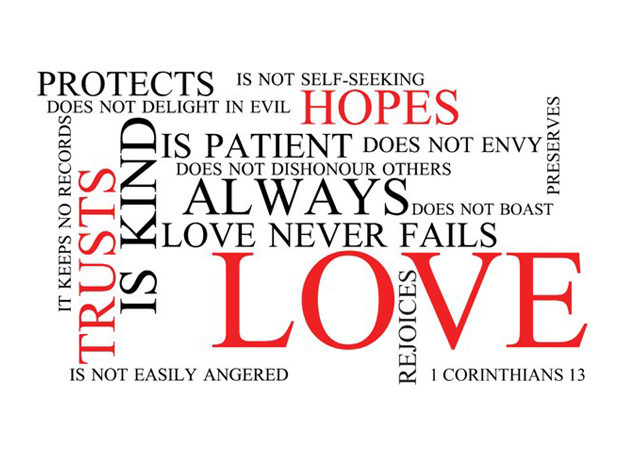
Although 1 Corinthians 13:4-8 may not provide the most complete definition of genuine love, it serves as a good starting point for understanding it. Often quoted at weddings, it actually describes some of the qualities and attributes that followers of Jesus are supposed to demonstrate toward everyone, not just the love of our lives.
Ok—altogether now:
Love is patient.
Love is kind.
Love isn’t jealous.
Love doesn’t brag.
Love isn’t arrogant.
Love isn’t rude.
Love doesn’t seek its own advantage.
Love isn’t irritable.
Love doesn’t keep a record of complaints.
Love isn’t happy with injustice.
Love is happy with the truth.
Love puts up with all things.
Love trusts in all things.
Love hopes for all things.
Love endures all things.
Love never fails.
That’s the way love is…or maybe can be, if we are willing.
So, if this rather simple definition of love is a plumbline to test our initial response toward others and the day ahead, how well are we doing?
Do these qualities show up in our initial thoughts toward a spouse? A child? A coworker?
Is love guiding what we post on social media?
Is it expressed in the way we treat our neighbor, the barista, or the flight attendant?
How do these attributes characterize the way you speak about or engage those with whom you disagree on politics or religion?
When we are confronted and maybe confounded by one of the myriad social issues dividing our communities, is our first instinct to respond with the love embodied in the life, teachings, and death of Jesus?
“Love one another, as I have loved you,” Jesus said. Frustratingly, this doesn’t give us a template or formula for how to respond. It offers no “four easy steps to loving your neighbor (and enemy!). What the love of Christ can do is move us and guide us into relationship and reconciliation with others. It can bend us toward people rather than away from them. The love of Christ—alive in us and animating our actions—inclines us to risk compassion, mercy, generosity, and self-giving. I am convinced that’s the way love is—and the way we are called to be as followers of Jesus.
At least for me, this is all much easier when I remember to start from a place of love. So, in the words of another old Quaker, William Penn, “Let us then try and see what Love will do” as our first motion. Who knows where it might lead us?
 Walking in the Way and Stumbling Toward Faithfulness