Many years ago, I worked as a budding minister with youth in the juvenile justice system and among runaways living on the streets of Portland, Oregon. A wonderful band of volunteers and I engaged in outreach efforts to get to know these young girls and boys and, if possible, walk alongside them in an often-challenging journey toward wholeness, healing, and restoration.
A poster greeted me daily as I entered the office where I worked. It pictured a homeless man sprawled out on a littered street. His sunken, sad eyes, urine-stained pants, and matted hair captured one we often turn away from or ignore—if we even notice them.
Far more haunting than the picture, however, was the phrase that cast a shadow over the poster and has continued to do so over the course of my life: “I really only love God as much as the person I love the least.”
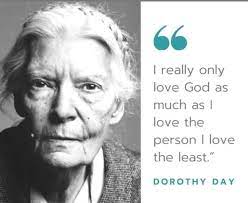
Ugh.
It is a dagger of a quote from that old prophet and Catholic Worker, Dorothy Day. “I really only love God as much as the person I love the least.”
Ugh, indeed.
The homeless man on the poster was not the likeness of either the person or the type of person I loved the least, but I am sure he was for some people. Since I was hanging out with kids in the city center, I often saw homeless men and women. More than once, I heard a well-dressed man say something like, “Get off my street, you piece of $h-t!” In those moments, I found myself much closer to the kind of person I loved the least.
The person you love the least can easily be a sanitized way of describing those we, in reality, hate. This feels especially true nowadays when our revulsion for others seems to have bubbled nearer the surface and gets expressed in less-filtered ways than seemed more common in the 1980s. Several recent studies detailing differences among people reveal that the actual degree of difference is not appreciably greater than it was several years ago. We may perceive a greater distinction and difference between us, but the real difference in perspective is often far less than we sometimes imagine.
At least according to some studies, what has changed is the degree to which we now HATE one another. Segmented and separated in our little ideological bubbles, threatened by racial and economic differences, and politically polarized within a strident and partisan culture, many find we cannot abide the OTHER—whomever our OTHER may be. And while I don’t believe the media is necessarily the boogeyman responsible for this reality, it does seem that nearly every outlet across the ideological spectrum traffics in and exploits our growing disdain for one another to generate a profit.
I don’t know if Dorothy Day is right—that we really only love God as much as the person we love the least. Everything in me rebels at this notion. Every fiber of my being wishes to resist the possibility that this is true. Forty years after first being confronted by this thought, however, I am increasingly convinced it is likely true. This is especially true when our “loving someone least” gives way to unabashed and unapologetic hatred.
As sad as this reality is, it provides an excellent opportunity for a group that is supposed to be known by their love for one another, for neighbor, and even those who might otherwise be our adversary and enemy. If this is genuinely at the heart of our witness and what authenticates our allegiance to Christ our Lord, then it may make this an especially great time to be the church.
Of course, this is a challenging task. I am neither delusional (at least in this matter) nor Pollyanna when it comes to overcoming our reputation for being a primary cause of so much hatred in the world. The church has a long way to go—a very long way—at still learning to love our enemies. We have a long way to go—a very long way—in learning to embrace our neighbors with compassion and grace. Maybe most sadly and unfortunately, we still have a long way to go—a very long way—in learning what it can and must mean to love one another within the Body of Christ as He first loved us.
I genuinely want my love for God to grow. If one avenue comes through reimagining and relearning how I treat and consider those I now “love the least,” I need to explore this more deeply. Rather than taking offense or becoming defensive, or worrying about how that person differs from me, maybe I can engage them with newfound compassion. Instead of seeing that person as a threat to my way of life or impinging upon my preferred reality, perhaps I can learn to understand their perspective and help them understand mine in inviting, winsome, and welcoming ways. Maybe, I can learn to disarm even my enemy through the power of love rather than coercion, control, and condemnation. Jesus seemed to do this well even while holding on to his integrity and conviction of truth.
Indeed, if being a Christian is really about being transformed into the image of Christ and the work of the Church is more about continuing to incarnate the Presence and ministry of Jesus than it is being free to have religious events or live in a society where all our values are codified into law, or all of our people are in political power—then this truly is a great time to be the church. We have the good work of love ahead of us in a time and place growing far too comfortable with hate.
As you reflect on that person or that group of people you love the least, what does this reveal in your spirit?
How well do you love God today, dear friend?
 Walking in the Way and Stumbling Toward Faithfulness